One ten-minute session. Total clarity for everyone.
Every WriteStories session follows a simple three-step cycle — producing actionable clinical data, a preserved creative story, and a clear family connection, all from a single sitting.
Free for up to 3 students. No credit card. No time limit.
From blank page avoidance to defensible clinical documentation.
The Student Writes
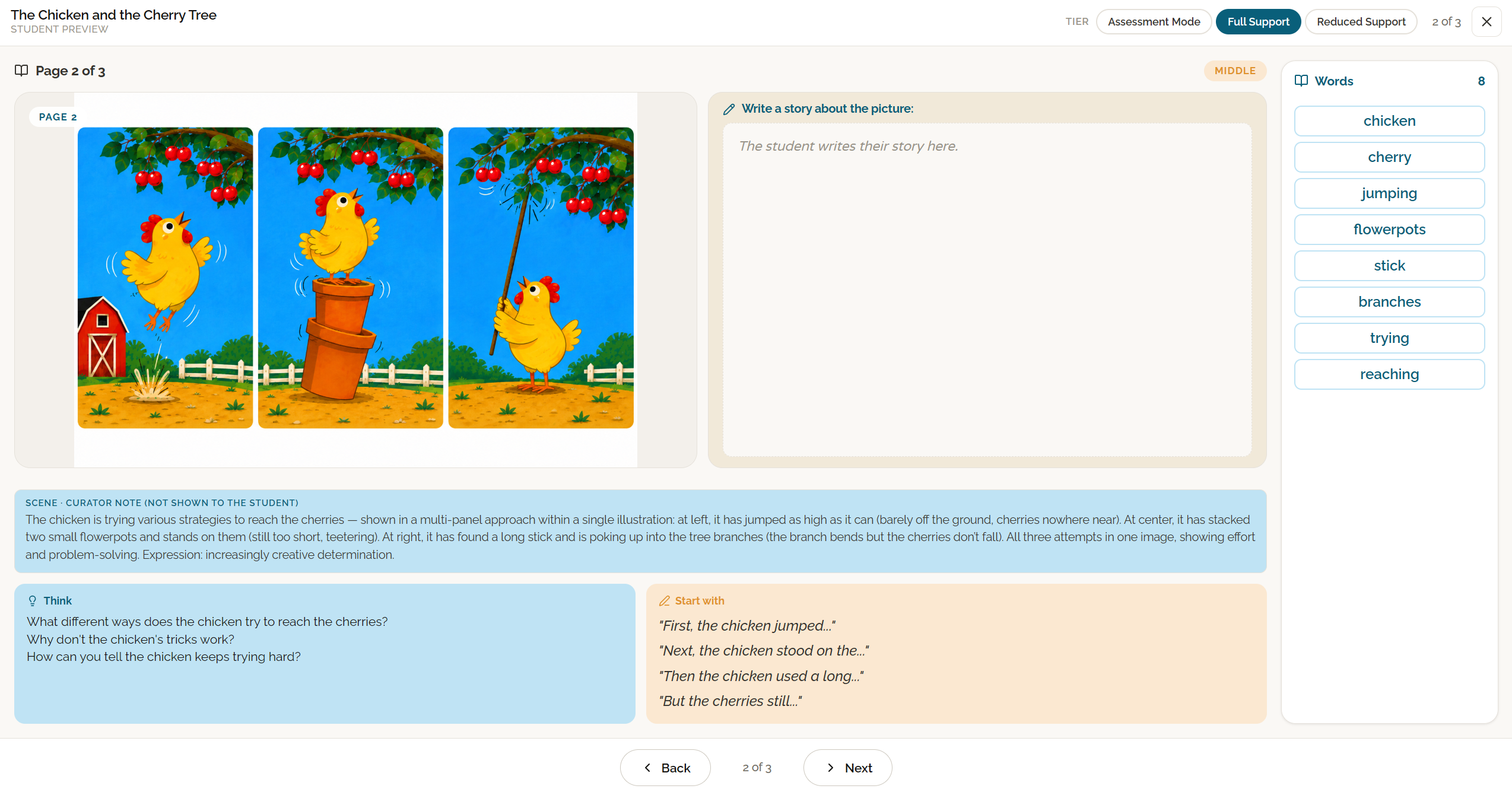
The child explores an illustrated, wordless book page by page, guided by whatever level of support their clinician sets — sentence starters, visual word banks, or unassisted in Assessment Mode.
• Eliminates blank-page anxiety with visual narrative anchors
• Built-in self-monitoring CUPS checklist at the end of each story
• Supports fade dynamically as the child gains independence
Automated Scoring & Note Drafting
The moment the story is submitted, WriteStories analyzes the text across both mechanical CUPS (capitalization, usage, punctuation, spelling) and all 7 Narrative Scoring Scheme (NSS) dimensions.
• Instant first-pass scoring on grammar, cohesion, and story structure
• Automated drafting of objective clinical progress notes
• Item-level logging: captures whether scaffolds were used verbatim, modified, or omitted
The Clinician Reviews & Finalizes
Suggested scores and drafted notes land in your clinical dashboard. You accept, adjust, or completely overwrite any element before it enters documentation.
• Clinician retains 100% evaluative control over every score and note
• (Coming Soon) One-click weekly therapist update generated for the family portal
• Exportable for your notes and progress reports
Same session. Exactly what each person needs to see.
Low-Frustration Expression
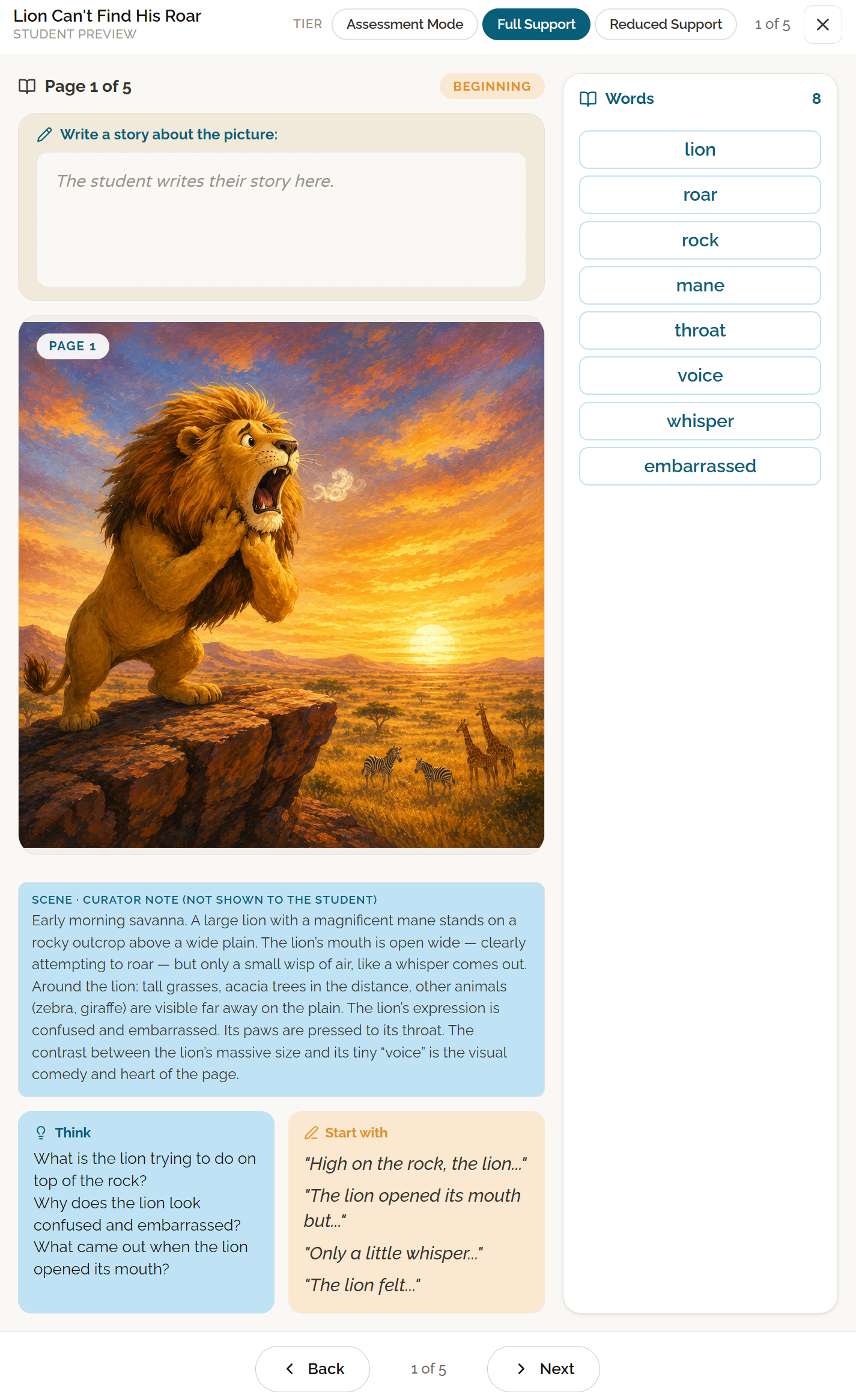
• What they see: Rich, wordless illustrations, an uncluttered typing/writing area, optional scaffold drawers (word banks, sentence starters), and a self-check checklist.
• What they do: Write their story, use or ignore supports as needed, complete their checklist, and publish to their permanent digital library of books.
• Access: Simple, child-friendly login managed directly by their clinician or parent.
Comprehensive Session Evidence
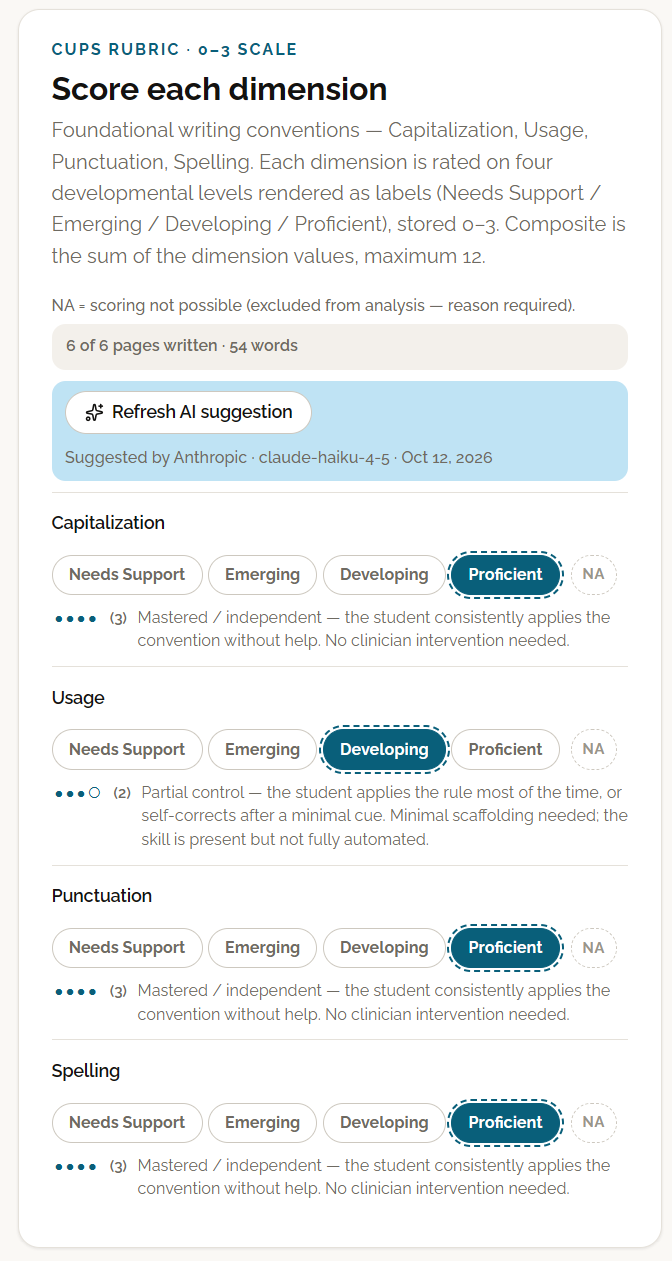
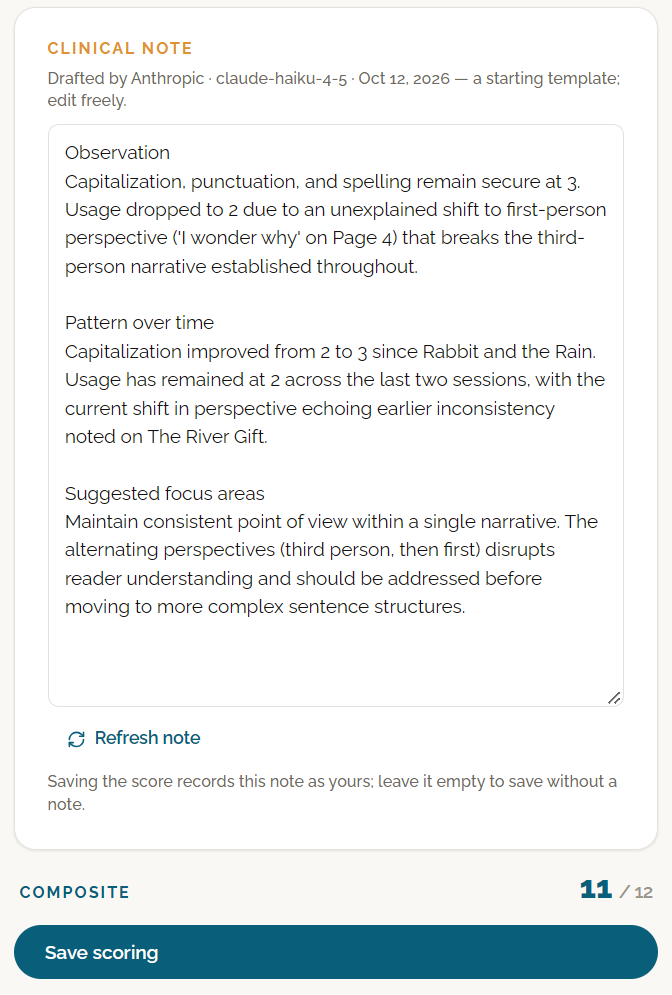
• What you see: Side-by-side story text, auto-suggested CUPS and NSS scores with confidence tags, item-level scaffold usage data, and a pre-drafted clinical session note.
• What you do: Review suggestions, adjust scores, finalize the session note, and (Coming Soon) optionally approve a 30-second weekly note for home carryover.
• Caseload impact: Routine scoring and note drafting completed in minutes, leaving your clinical energy for direct therapy.
Plain-Language Connection
• What they see: A notification when a story is finished, the illustrated book their child wrote, plain-language progress trends, and (Coming Soon) their SLP’s weekly note.
• What they do: Read the story together, celebrate growth, and try one simple, low-pressure conversational suggestion at home — no worksheets or timers.
• Cost: 100% permanently free for families connected to a treating clinician.
Designed for clinical rigor and family clarity.
The student experience
A screen-by-screen walkthrough of a complete session.
The SLP dashboard
The full dashboard reference — every view, every chart.
(Coming Soon) The family dashboard
The Ms. Rivera Says card, story feed, and progress bars explained.
NSS auto-scoring
How the two-layer scoring pipeline actually works.
See a session for yourself.
Start free with up to 3 students, or set up your family's free account.