WriteStories gives kids a scaffolded, illustrated way to find their words — and gives the SLPs and families around them a clear, plain-language view of the progress underneath it.
Permanent free tier for SLPs (up to 3 active students) · Always free for client families · No credit card required.
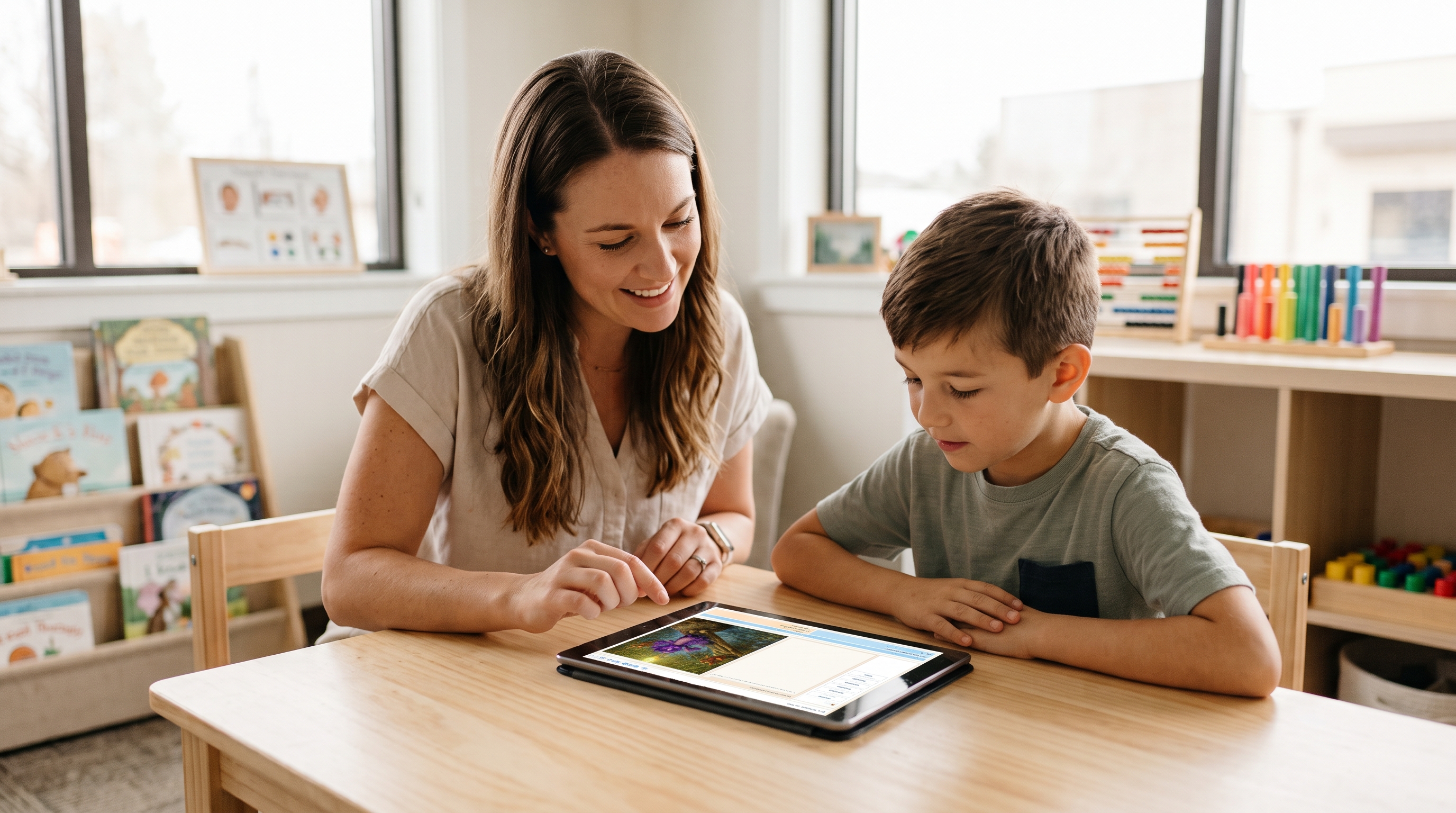
"Emma's been working on describing what characters are thinking and feeling — try asking her about it tonight."

.svg)
.svg)
.svg)
A caseload tool built around the Narrative Scoring Scheme — not a generic writing app with clinical language bolted on.
No clinical jargon, no scores to decode — just your child's stories, plain-language progress, and a weekly note from their therapist.
Every part of the platform is built around narrative language specifically — story grammar, scaffolded support that fades on purpose, and a clear line back to the technique it's grounded in.
A library of 20 illustrated books, and growing. The visual scaffold does the work a blank page can't — the character, the setting, and the problem are already there. The child's job is finding the words.
Sentence starters, word banks, and thought questions scale down as a child gets more independent — tracked at the item level, not guessed at.

WriteStories auto-scores writing on both CUPS and the Narrative Scoring Scheme (NSS), and generates drafted session notes. You review, edit, and finalize everything — saving documentation time while keeping you in full clinical control.
Families see a plain-language note from their child's SLP every week, not just a progress bar — so practice at home connects to what's happening in session.
Every part of the platform is built around narrative language specifically — story grammar, scaffolded support that fades on purpose, and a clear line back to the technique it's grounded in.
Narrative Flow
1. A student tells a story out loud about a dog that got lost and found its way home.
2. With visual support, she chooses one sentence to write down: "the dog ran home."
3. A self-monitoring checklist prompts her to check capitalization and punctuation.
4. She revises her work independently to: "The dog ran home."
What Gets Recorded & Drafted in the Session Note
✓ One complete sentence written
✓ Capitalization correction made independently after one prompt
✓ Punctuation check completed
— the kind of specific, objective evidence a clinician needs for defensible session notes.
WriteStories was designed first for speech-language pathologists working on narrative language — and that's who it serves best today. But the challenge it addresses — helping a child move from ideas to a structured written story — isn't owned by any one profession. The same illustrated books, scaffolding, and NSS-based scoring are built to serve:
• Reading specialists & literacy interventionists — working on narrative structure and written expression as part of literacy instruction.
• Educational therapists — treating narrative and written organization as part of executive-function and language goals.
• Special-education teachers — supporting IEP narrative and writing objectives in the classroom.
• Dyslexia & structured-literacy practitioners — for whom foundational, scaffolded writing is squarely in scope.
Because the tool is built on the universal structure of narrative, it fits wherever a child needs help turning ideas into written stories.
WriteStories' clinical pilot is starting soon; outcome results aren't published yet, but the platform is available today. Below is the published, technique-level research the platform's clinical design is grounded in.
Create a free professional account today to start using WriteStories with up to 3 active students. Or explore how our free family portal supports home practice.
Permanent free tier · No credit card required · Upgrade anytime to unlimited caseload for $239/yr
